- Trail Runner Australia
- Posts
- A love letter to running
A love letter to running
The Running Ground, by Nicholas Thompson, is a memoir that celebrates the gift of running and the complexity of life.

Stuart Watt
January 23, 2026
In partnership with

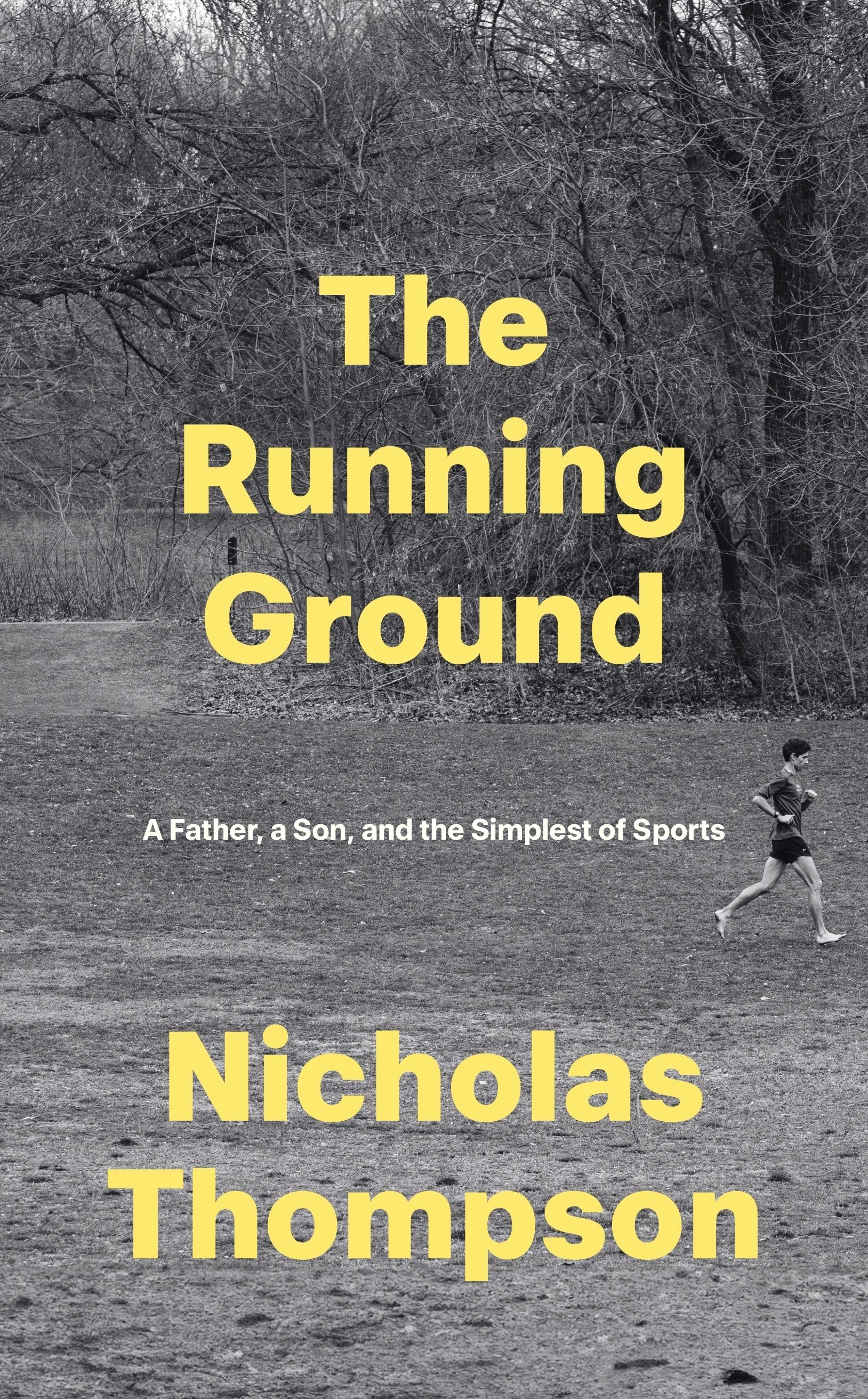
A book about the power of running.
In The Running Ground: A Father, a Son and the Simplest of Sports, journalist Nicholas Thompson has produced a compelling read that’s part memoir and part tribute to his father. But most of all, it’s a love letter to running.
In some ways I found it difficult to get my head around this book. There’s no real narrative arc as such. It’s more a chronological recounting of Thompson’s life and his relationship with his father, and ultimately his sons, told through the medium of running.
At its centre is the story of how Thompson defied ageing to go from being a 2 hour 40 minute marathoner to breaking 2:30, with the help of a crack team from Nike. But it’s so much more than that.
Interwoven are the stories of five other runners that help to unpack the impact the sport can have. Thompson writes with the economy of a news reporter rather than the flair of a feature writer. But if anything, that makes these stories all the more powerful. This is a book full of heart.
One Simple Scoop For Better Health

The best healthy habits aren't complicated. AG1 Next Gen helps support gut health and fill common nutrient gaps with one daily scoop. It's one easy routine that fits into real life and keeps your health on track all day long. Start your mornings with AG1 and keep momentum on your side.
These days, Thompson is the chief executive of The Atlantic, a long-form news magazine founded in the US almost 170 years ago. He’s been editor in chief at technology, science and culture magazine Wired and a senior editor at another long-form news magazine The New Yorker. It’s an impressive CV.
He comes from good political stock. Thompson’s mother’s family were political blue-bloods. His maternal great-grandmother had been the first female congresswoman from New York. His maternal grandfather was Paul Nitze, who served as undersecretary of defence in the administration of President Lyndon Johnson.
He also comes from good athletic stock. His father, Scott Thompson, was a track star in high school and college and young Nick followed in his footsteps. He excelled at high school and was invited to join the cross country team at Stanford University.
But a combination of injuires and the pressure to do well in class saw him quit the team. He turned instead to guitar, developing what he describes in the book as an idiosyncratic fingerpicking style.
Thompson junior ran his first marathon while fully in thrall to his guitar, and finished in 3 hours 18 minutes. Running such a fast time on more or less no preparation is testament to the fact he was born with considerable natural talent as an endurance athlete.
Sins of the father
I think it’s fair to describe Scott Thompson as a complex character. He was clearly brilliant. He won a scholarship to Stanford and became a Rhodes Scholar. On his return to the US he met and married Nina Nitz. Her family connections meant his star continued to rise.
By the late 1970s, when Nick was still in pre-school, he was being positioned within the Republican party as a possible candidate to run for office. He won a White House Fellowship and became known as an advocate for a Hawkish approach to the Cold War.
In the book, Nick outlines how close his father went to being named as a senior diplomat in the State Department after the election as president of Ronald Reagan. He lost out to Paul Wolfowitz who went on to be a key architect of neo-conservatism and a pivotal figure in the George W Bush White House as it responded to the September 11 terror attacks in 2001.
But just as he entered his 40s, Thompson senior’s world began to crash down around him. He was already drinking heavily but around this time he lost control of “his repressed sexual feelings towards men”. He began an affair with a much younger man and his marriage fell apart.
Throughout this period he was running, and Nick details how the running acted as a “centripital force” that held his father’s life together. In his early 40s Scott was diagnosed as HIV-positive - a diagnosis that was made in error.
After a period living with his son in Washington, during which time they co-wrote a book, the elder Thompson ultimately moved to Asia where he was broke, addicted to sex and sometimes suicidal. There he died of a heart attack in his mid-70s.
Dad, you weren’t easy. But I love you.
Success and setback
Despite being a high school star, as a young man Nick Thompson was never an elite runner. He spent his 20s trying to break three hours for the marathon. In four attempts he only came within 30 minutes of his goal twice.
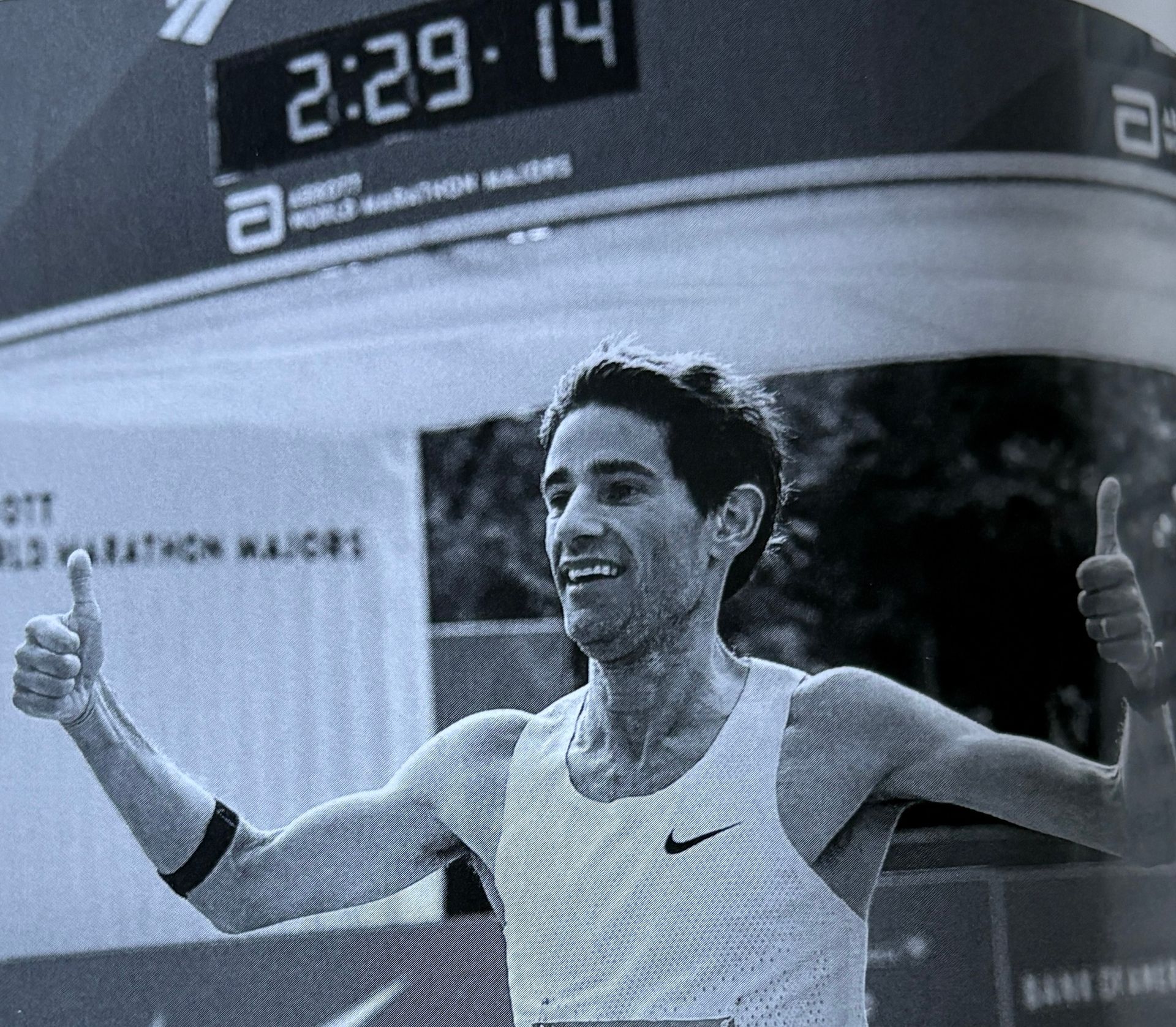
The team from Nike helped Thompson run faster than he ever had before. Image: The Running Ground, courtesy of Nike.
By 2005 Thompson’s career was taking off and so was his running. As he entered his 30s he’d finally broken three hours and knew he could run faster. He joined a running team based out of Central Park where he came under the guidance of coach Tony Ruiz.
At the New York Marathon in November 2005 Thompson ran 2:43 to finish 146th out of more than 37,000 starters. Shockingly, despite being in the shape of his life, by Christmas he’d been diagnosed with thyroid cancer. After two operations and a course of radiation treatment, the cancer was gone.
Thompson wanted to return to running, but he was on medication that meant he was “perpetually dizzy” and had lost strength and coordination. A two-mile run would result in double-vision, and a desultory trudge back home.
My diagnosis had come right after my triumphant marathon, and I believed the only way to put in in the past was to run again.
With hard work and stubborness he steadily improved, and two years after the diagnosis he finished the New York Marathon 13 seconds faster than he had prior to his illness.
Choose Natural Relaxation Tonight, Thrive Tomorrow

CBDistillery’s expert botanist has formulated a potent blend of cannabinoids to deliver body-melting relaxation without the next-day hangover.
Enhanced Relief Gummies feature 5mg of naturally-occurring Delta-9 THC and 75mg of CBD to help your body and mind relax before bedtime. Save 25% on your first order with code HNY25.
Need for speed
When he was in his early 40s, Nike reached out to Thompson with an offer - they were pairing runners like him with elite coaches to see what results could be achieved. His journalist’s skepticism kicked in immediately - surely it was no coincidence the editor of Wired was being offered this chance. But he was also intrigued. So after a period of introspection he said yes.
It’s important to note Thompson was already a gun runner. Before he started working with Nike, his New York Marathon finishing times were 2:43, 2:43, 2:42, 2:42, 2:45, 2:46, 2:46 and 2:43.
On one level he’d done well not to decline. But he wasn’t getting any faster either. Could Nike change that? The company put coach Stephen Finley, physical trainer Joe Holder and sports scientist Brett Kirby at Thompson’s disposal and together they devised a training plan.
I told them ageing made me feel like a tyre slowly deflating in the cold. They assured me that with science and a little bit of math, there was a way to pump some air in.
Thompson’s dream was to break 2 hours 40 minutes. But with their guidance, and Kirby’s dedication in particular, he managed to go much faster than that.
We all contain different versions of ourselves, buried deep inside. This faster Nick had always been there, perhaps for 25 years… I wondered then, as I wonder now, what other versions of me exist that there may no longer be time to find.
Going long
Thompson says when he dreams of running, it’s not the track or the road that comes to him, but the trail. And ultimately his running odyssey has led him to the world of ultras. In 2021 he ran 50k in 3:04:36, setting an age record for the distance.
Getting there meant adopting a new mindset, a lesson he learned in DNFing the Tunnel Hill 50-mile race in 2021. To run that far - 82k - he needed a whole new approach, both psychologically and physiologically.
He needed to learn how to fuel his body over that sort of distance and how to cope with the “deep mental fatigue” that comes with ultra running.
Marathon runners get tired and miserable, but they rarely get so disorientated and exhausted that they have to step off the course, lay their heads in the moss, and take a nap. Marathons are also generally linear: you run the same speed the whole way; or you run slower and slower after a certain point. Ultramarathons, as I would eventually learn, don’t work that way. You can run fast and then slow and then fast again.
By the time he was 49, Thompson was on the start line of his first 100k race, Twisted Branch in Upstate New York. The race began two hours before sunrise and traversed horse pastures, gravel roads, creeks and ascents so steep “you felt you could stretch your hands straight in front of you and touch the ground ahead”.
After about 50k he realised he’d been running for more time than ever before, and he still had a marathon and a bit to go. His legs and abdomen hurt and he felt dizzy. So he broke with tradition and stopped tracking his splits on his watch. He switched off his heart rate monitor.
I tried to imagine I was young Nick, bounding through the forests of New England… I let go of my concerns about time, pace, heart rate, cadence. I didn’t worry how many miles had passed or how many there were to go. I just kept moving forward…
The effect was transformative. Around the 85k mark Thompson “felt a touch of sadness” that he was so close to finishing. It was, he says, “beautiful to run these trails without the pressure of wanting to finish in a certain time or to hold on to a specific place”.
Legacy
I said at the outset this book is like a love letter to running. But it’s clear there has always been a third-party in his love affair with the sport - his father. So I suppose it’s inevitable that it’s a gift he’s also passing on to his three sons.
And herein lies the real message of this book - however it comes into your life, running has the power to change it forever.
My father led a deeply complicated and broken life. But he gave me many things, including the gift of running - a gift that opens the world to anyone that accepts it.
Upcoming Events
There are way too many events for me to list everything that’s happening around the country, but here is a selection of upcoming races (with a bias towards South East Queensland).
Event | Location | Date |
|---|---|---|
Beerwah, Qld | 31 January 2026 | |
Brisbane, Qld | 1 February 2026 | |
Robe, SA | 7 February 2026 | |
Kosciuszko National Park, NSW | 14 February 2026 | |
Mt Buller, Vic | 20 February 2026 | |
Wilson’s Promontory, Vic | 21 February 2026 | |
Mt Baw Baw, Vic | 1 March 2026 | |
Glenview, Qld | 1 March 2026 | |
Warburton, Vic | 7-9 March 2026 | |
Gold Coast, Qld | 13 March 2026 |
The Running Calendar website is a great source if you want a comprehensive understanding of what’s available around Australia.